
 liuq
ce5b2cf93a
点击视频不会退出窗口
liuq
ce5b2cf93a
点击视频不会退出窗口
|
hace 3 meses | |
|---|---|---|
| assets | hace 3 meses | |
| documents | hace 3 meses | |
| libs | hace 3 meses | |
| scripts | hace 3 meses | |
| src | hace 3 meses | |
| .flake8 | hace 3 meses | |
| .gitignore | hace 3 meses | |
| LICENSE | hace 3 meses | |
| README.en.md | hace 3 meses | |
| README.md | hace 3 meses | |
| authorize_python_access.sh | hace 3 meses | |
| build.json | hace 3 meses | |
| checke_opus.sh | hace 3 meses | |
| entitlements.plist | hace 3 meses | |
| format_code.bat | hace 3 meses | |
| format_code.sh | hace 3 meses | |
| main.py | hace 3 meses | |
| pyproject.toml | hace 3 meses | |
| requirements.txt | hace 3 meses | |
| requirements_mac.txt | hace 3 meses | |
| run.bat | hace 3 meses | |
| 小智.spec | hace 3 meses |
README.en.md
py-xiaozhi


English | 简体中文
Project Introduction
py-xiaozhi is a Python-based Xiaozhi voice client, designed to learn coding and experience AI voice interaction without hardware requirements. This repository is ported from xiaozhi-esp32.
Demo
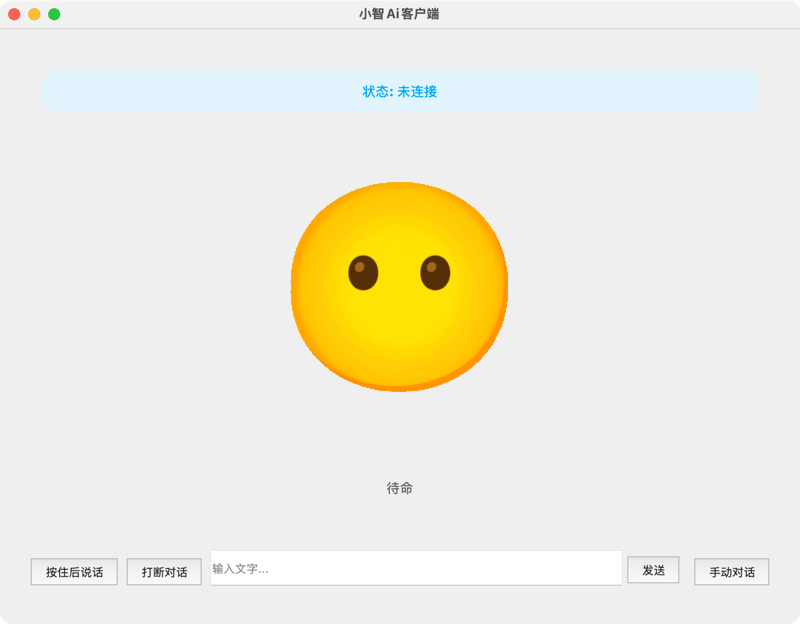
Features
🎯 Core AI Capabilities
- AI Voice Interaction: Supports voice input and recognition, enabling intelligent human-computer interaction with natural conversation flow
- Visual Multimodal: Supports image recognition and processing, providing multimodal interaction capabilities and image content understanding
- Intelligent Wake-up: Supports multiple wake word activation for hands-free interaction (configurable)
- Continuous Dialogue Mode: Implements seamless conversation experience, enhancing user interaction fluidity
🔧 MCP Tools Ecosystem
- System Control Tools: System status monitoring, application management, volume control, device management
- Calendar Management Tools: Full-featured calendar system with create, query, update, delete events, intelligent categorization and reminders
- Timer Tools: Countdown timer functionality with delayed MCP tool execution and parallel task management
- Music Player Tools: Online music search and playback with playback controls, lyrics display, and local cache management
- 12306 Query Tools: 12306 railway ticket query with train tickets, transfer queries, and route information
- Search Tools: Web search and content retrieval with Bing search integration and intelligent content parsing
- Recipe Tools: Rich recipe database with search, category browsing, and intelligent recommendations
- Map Tools: Amap services with geocoding, route planning, nearby search, and weather queries
- Bazi Fortune Tools: Traditional Chinese fortune-telling with Bazi calculation, marriage analysis, and lunar calendar queries
- Camera Tools: Image capture and AI analysis with photo recognition and intelligent Q&A
🏠 IoT Device Integration
- Device Management Architecture: Unified device management based on Thing pattern with asynchronous property and method calls
- Smart Home Control: Supports lighting, volume, temperature sensors, and other device control
- State Synchronization: Real-time status monitoring with incremental updates and concurrent state retrieval
- Extensible Design: Modular device drivers, easy to add new device types
🎵 Advanced Audio Processing
- Multi-level Audio Processing: Supports Opus codec and real-time resampling
- Voice Activity Detection: VAD detector for intelligent interruption with real-time voice activity monitoring
- Wake Word Detection: Sherpa-ONNX-based offline speech recognition with multiple wake words and pinyin matching
- Audio Stream Management: Independent input/output streams with stream rebuild and error recovery
- Audio Echo Cancellation: Integrated WebRTC audio processing module providing high-quality echo cancellation
- System Audio Recording: Supports system audio recording with audio loopback processing
🖥️ User Interface
- Graphical Interface: Modern PyQt5-based GUI with Xiaozhi expressions and text display for enhanced visual experience
- Command Line Mode: CLI support suitable for embedded devices or GUI-less environments
- System Tray: Background operation support with integrated system tray functionality
- Global Hotkeys: Global hotkey support for improved usability
- Settings Interface: Complete settings management interface with configuration customization
🔒 Security & Stability
- Encrypted Audio Transmission: WSS protocol support ensuring audio data security and preventing information leakage
- Device Activation System: Dual v1/v2 protocol activation with automatic verification code and device fingerprint handling
- Error Recovery: Complete error handling and recovery mechanisms with reconnection support
🌐 Cross-platform Support
- System Compatibility: Compatible with Windows 10+, macOS 10.15+, and Linux systems
- Protocol Support: WebSocket and MQTT dual protocol communication support
- Multi-environment Deployment: GUI and CLI dual modes adapting to different deployment environments
- Platform Optimization: Audio and system control optimization for different platforms
🔧 Developer Friendly
- Modular Architecture: Clean code structure with clear responsibility separation for secondary development
- Async First: Event-driven architecture based on asyncio for high-performance concurrent processing
- Configuration Management: Hierarchical configuration system with dot notation access and dynamic updates
- Logging System: Complete logging and debugging support
- API Documentation: Detailed code documentation and usage guides
System Requirements
Basic Requirements
- Python Version: 3.9 - 3.12
- Operating System: Windows 10+, macOS 10.15+, Linux
- Audio Devices: Microphone and speaker devices
- Network Connection: Stable internet connection (for AI services and online features)
Recommended Configuration
- Memory: At least 4GB RAM (8GB+ recommended)
- Processor: Modern CPU with AVX instruction set support
- Storage: At least 2GB available disk space (for model files and cache)
- Audio: Audio devices supporting 16kHz sampling rate
Optional Feature Requirements
- Voice Wake-up: Requires downloading Sherpa-ONNX speech recognition models
- Camera Features: Requires camera device and OpenCV support
Read This First
- Carefully read 项目文档 for startup tutorials and file descriptions
- The main branch has the latest code; manually reinstall pip dependencies after each update to ensure you have new dependencies
Zero to Xiaozhi Client (Video Tutorial)
Technical Architecture
Core Architecture Design
- Event-Driven Architecture: Based on asyncio asynchronous event loop, supporting high-concurrency processing
- Layered Design: Clear separation of application layer, protocol layer, device layer, and UI layer
- Singleton Pattern: Core components use singleton pattern to ensure unified resource management
- Plugin System: MCP tool system and IoT devices support plugin-based extension
Key Technical Components
- Audio Processing: Opus codec, WebRTC echo cancellation, real-time resampling, system audio recording
- Speech Recognition: Sherpa-ONNX offline models, voice activity detection, wake word recognition
- Protocol Communication: WebSocket/MQTT dual protocol support, encrypted transmission, auto-reconnection
- Configuration System: Hierarchical configuration, dot notation access, dynamic updates, JSON/YAML support
Performance Optimization
- Async First: Full system asynchronous architecture, avoiding blocking operations
- Memory Management: Smart caching, garbage collection
- Audio Optimization: 5ms low-latency processing, queue management, streaming transmission
- Concurrency Control: Task pool management, semaphore control, thread safety
Security Mechanisms
- Encrypted Communication: WSS/TLS encryption, certificate verification
- Device Authentication: Dual protocol activation, device fingerprint recognition
- Access Control: Tool permission management, API access control
- Error Isolation: Exception isolation, fault recovery, graceful degradation
Development Guide
Project Structure
py-xiaozhi/
├── main.py                     # Application main entry (CLI argument handling)
├── src/
│   ├── application.py          # Application core logic
│   ├── audio_codecs/           # Audio codecs
│   │   ├── aec_processor.py    # Audio echo cancellation processor
│   │   ├── audio_codec.py      # Audio codec base class
│   │   └── system_audio_recorder.py  # System audio recorder
│   ├── audio_processing/       # Audio processing modules
│   │   ├── vad_detector.py     # Voice activity detection
│   │   └── wake_word_detect.py # Wake word detection
│   ├── core/                   # Core components
│   │   ├── ota.py             # Over-the-air update module
│   │   └── system_initializer.py # System initializer
│   ├── display/                # Display interface abstraction layer
│   ├── iot/                    # IoT device management
│   │   ├── thing.py           # Device base class
│   │   ├── thing_manager.py   # Device manager
│   │   └── things/            # Concrete device implementations
│   ├── mcp/                    # MCP tool system
│   │   ├── mcp_server.py      # MCP server
│   │   └── tools/             # Various tool modules
│   ├── protocols/              # Communication protocols
│   ├── utils/                  # Utility functions
│   └── views/                  # UI view components
├── libs/                       # Third-party native libraries
│   ├── libopus/               # Opus audio codec library
│   ├── webrtc_apm/            # WebRTC audio processing module
│   └── SystemAudioRecorder/   # System audio recording tool
├── config/                     # Configuration file directory
├── models/                     # Speech model files
├── assets/                     # Static resource files
├── scripts/                    # Auxiliary scripts
├── requirements.txt            # Python dependency package list
└── build.json                  # Build configuration file
Development Environment Setup
# Clone project
git clone https://github.com/huangjunsen0406/py-xiaozhi.git
cd py-xiaozhi

# Install dependencies
pip install -r requirements.txt

# Code formatting
./format_code.sh

# Run program - GUI mode (default)
python main.py

# Run program - CLI mode
python main.py --mode cli

# Specify communication protocol
python main.py --protocol websocket  # WebSocket (default)
python main.py --protocol mqtt       # MQTT protocol
Core Development Patterns
- Async First: Use
async/awaitsyntax, avoid blocking operations - Error Handling: Complete exception handling and logging
- Configuration Management: Use
ConfigManagerfor unified configuration access - Test-Driven: Write unit tests to ensure code quality
Extension Development
- Add MCP Tools: Create new tool modules in
src/mcp/tools/directory - Add IoT Devices: Inherit from
Thingbase class to implement new devices - Add Protocols: Implement
Protocolabstract base class - Add Interfaces: Extend
BaseDisplayto implement new UI components
State Transition Diagram
                        +----------------+
                        |                |
                        v                |
+------+  Wake/Button  +------------+   |   +------------+
| IDLE | -----------> | CONNECTING | --+-> | LISTENING  |
+------+              +------------+       +------------+
   ^                                            |
   |                                            | Voice Recognition Complete
   |          +------------+                    v
   +--------- |  SPEAKING  | <-----------------+
     Playback +------------+
     Complete
Contribution Guidelines
We welcome issue reports and code contributions. Please ensure you follow these specifications:
- Code style complies with PEP8 standards
- PR submissions include appropriate tests
- Update relevant documentation
Community and Support
Thanks to the Following Open Source Contributors
In no particular order
Xiaoxia zhh827 SmartArduino-Li Honggang HonestQiao vonweller Sun Weigong isamu2025 Rain120 kejily Radio bilibili Jun Cyber Intelligence
Sponsorship Support
Thanks to All Sponsors ❤️
Whether it's API resources, device compatibility testing, or financial support, every contribution makes the project more complete

